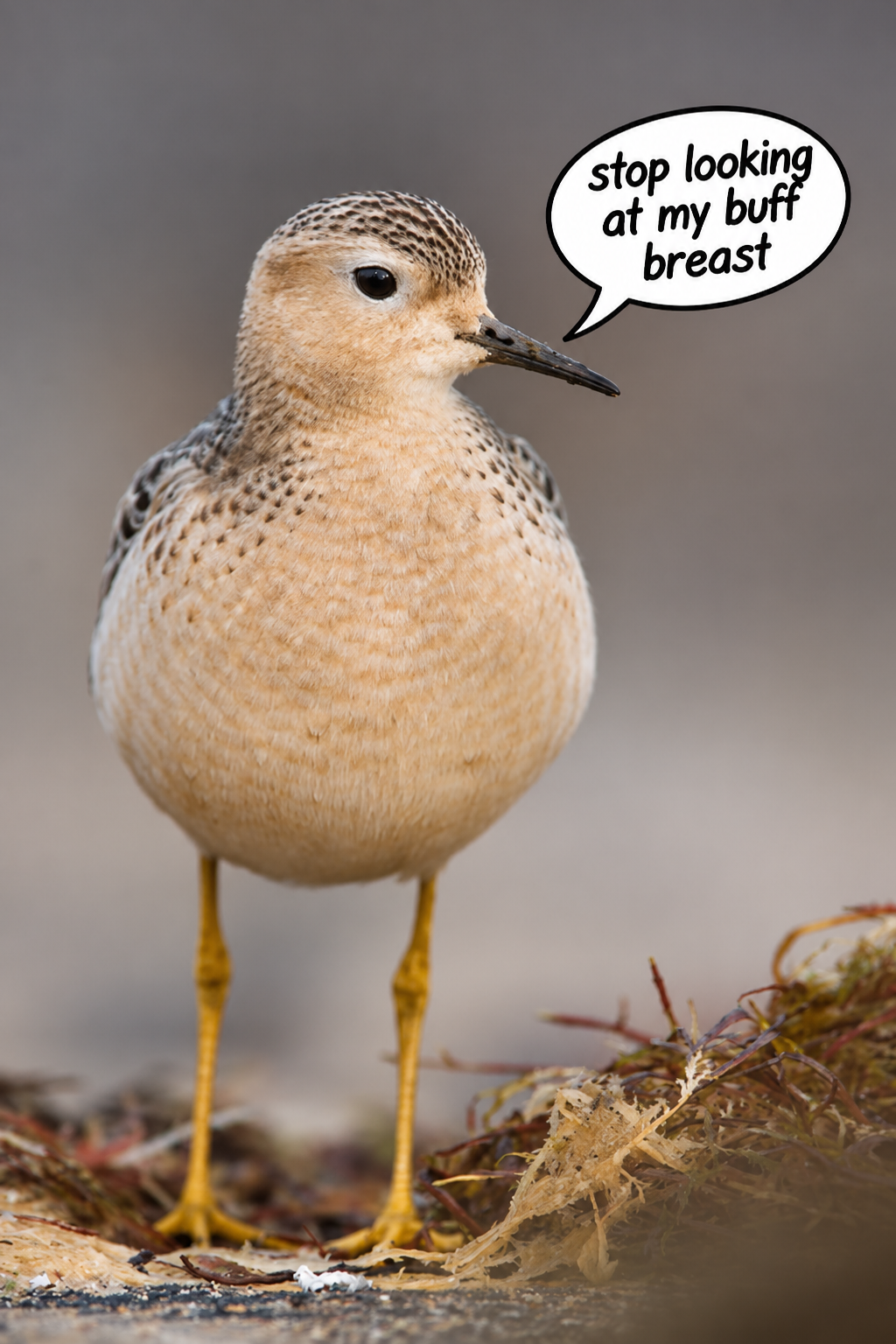
A puffed-up chest, impressive dance moves, and a name that's just begging for a few jokes!
Welcome back to Dirty Birds, the Perv Feeder™ blog series where we introduce you to real birds with names that make you do a double take.
We've already met the Great Tit and the European Shag. This week, we're introducing a bird that knows how to work what Mother Nature gave it.
Say hello to the Buff-breasted Sandpiper (Calidris subruficollis)!
And trust us, this little bird knows how to show off its assets. 😂
What Is a Buff-breasted Sandpiper?
Despite its rather impressive-sounding name, the Buff-breasted Sandpiper isn't spending its mornings at the gym.
The word buff refers to its beautiful, warm, tan-colored feathers, particularly around its chest and belly.
These small shorebirds are about 7–8 inches long, with bright yellowish legs, a short dark bill, and large, expressive eyes.
Think of a tiny feathered bodybuilder, minus the protein shakes.
And while most sandpipers spend their days exploring muddy shorelines, this one prefers grassy fields and open prairies.
Apparently, this sandpiper didn't get the memo about being a shorebird.
Where Can You Find These Buff Little Birds?
Buff-breasted Sandpipers breed in the Arctic tundra of northern Alaska and Canada.
When winter approaches, they embark on an incredible migration all the way to South America, spending the nonbreeding season primarily in grasslands of Argentina, Uruguay, and Brazil.
That's thousands of miles of flying!
During migration, you might spot them in short-grass prairies, agricultural fields, pastures, or even golf courses.
Imagine showing up for a round of golf and discovering a buff little bird strutting across the fairway.
Talk about distracting the competition!
The Males Really Know How to Put on a Show
Here's where things get interesting.
During breeding season, male Buff-breasted Sandpipers gather in loose groups called leks, where they compete for the attention of females.
And their courtship routine is something else!
They puff out their chests, raise their wings, stretch their necks, and perform elaborate displays.
Basically, imagine a group of guys at the beach flexing their muscles whenever someone attractive walks by.
Except these guys have feathers.
And their dance moves are probably better.
The females choose their mates, and afterward, they handle nesting and raising the chicks without help from the males.
Apparently, the guys are more interested in showing off than changing diapers.
What's on the Menu?
Buff-breasted Sandpipers primarily eat insects and other small invertebrates, including beetles, flies, spiders, and worms.
They search for food by walking through grassy areas, stopping to grab whatever tasty little creature catches their attention.
Unfortunately, that means you probably won't find one enjoying a snack from your backyard Perv Feeder™.
But we can dream.
A Little Bird Worth Protecting
Despite their funny name and entertaining courtship displays, Buff-breasted Sandpipers face serious conservation challenges.
Their populations have declined dramatically due to historical hunting and the loss of grassland habitats throughout their migration routes.
Today, the species is considered Near Threatened, making grassland conservation especially important.
Because even the buffest birds need a safe place to live.
Final Thoughts: Small Bird, Big Personality!
The Buff-breasted Sandpiper proves that you don't need to be big to make an impression.
With its golden chest, incredible migration, and outrageous courtship routine, this little bird has more personality than some people we've met.
And honestly, any bird willing to puff out its chest and perform an elaborate dance to impress a potential mate deserves a little recognition.
Stay tuned for more Dirty Birds, where we continue exploring nature's funniest bird names and the fascinating creatures behind them.
Perv Feeder™ — Making Bird Watching a Little More Interesting!
